02 June 2011

Jurong Bird Park

Following the wonderful experiences at the Singapore Zoo (4 visits to date), an outing to the Jurong Bird Park was going to be inevitable (2 visits so far).  Especially when I found out that there are 4600 birds in residence, of which 1000 are flamingos and another 1000 are lorikeets.  That still left me with vultures, eagles, toucans, hornbills, macaws, penguins, flightless birds and so on.

Can you imagine the feast my eyes and senses endured when I happened upon 92 species of some of the most amazingly coloured parrots from everywhere in the world.  The blues, the reds, the greens, gold, pale pink, purest of white.  Wow, my camera was working overtime.

For a small island, Singapore manages to have "the world's largest..." of many things and the Bird Park at 20.2ha is just such one example.  A multi-award winner, only avian hospital in Asia-Pacific and an Official Rescue Avian Centre, this park is committed to conservation, education and breeding of avians.

Here is a small collection for your perusal. 

Flamingos

Supposedly pink, although they looked quite orange to me, the flamingos habitate in saltwater lakes and lagoons, south of the North American continent and the Galapagos Islands.  Their pink plummage is a result of certain pigments found in the food they eat. 

Pink Flamingos

Lorikeets

Australasian natives, these magnificently coloured lorikeets are cheeky, noisy and bold.  My brother was tickled-pink when one of the lories befriended him.  The 3000 square metres, 9 storeys high lorry loft provides sufficient space for 1000 lorries, a suspension bridge and two-tiered central feeding tower.

My brother is making friends.
The multi-coloured lorikeets.

Macaws

Native to Central and South America, the macaws are part of the parrot family and mostly live in rainforests.  Their facial feather patterns are like fingerprints, different and unique to each bird.  They are serious chatterboxes, screeching and squawking their way through the day for fun, to mark their territory and simply to just talk to each other. 

Blue and gold macaws
My jigsaw puzzle version of the Scarlet Macaws
Parrots

Living in tropical and subtropical regions, there are 372 species.  Along with crows, magpies, jays and ravens, parrots are among the most intelligent birds, hence their ability to imitate human voices.  Monogamous breeders, they usually nest in cavities instead of building nests in trees like other birds.


Pelicans

According to fossil records the pelicans have been around for 30 million years.  In medieval Europe it was a symbol of piety. There are 8 major species of which the Dalmatian pelican has the widest wingspan at 3m and the Australian has the longest bill with a record length of 49cm.

This isn't feeding frenzy.  This is feeding madness.

Pink-backed Pelican residing in Africa & south Arabia
Dalmatian Pelican native to certain parts of Eastern Europe.
I love the scruffy head.  No brushing for this fella.

Shoebill Stork

Check out this funny looking stork with a bill shaped like a Dutch wooden clog.  Native to Africa, the shoebill has a statue-like habit whilst waiting for prey.  Surprisingly it preys on young crocodiles.  Who would have thought it could rank higher on the food chain whilst the crocs are babies.

Shoebill Stork

Toucans & Hornbills

On first sight both species appear to belong to the same family.  That is not the case.  The hornbill is a much larger bird and also has a casque on top of its bill (like a hump).  Interestingly the hornbill is the coat of arms for Malaysia's second largest state, Sarawak. 

Bar-pouched Wreathed Hornbill
Knobbed Hornbill
Bushy-crested Hornbill
Toco Toucan
Red-billed Toucan

Vultures & Eagles

Scavenging birds, they usually feed on the carcasses of dead animals. They are found on every continent except Australia and Antarctica.  The corrosiveness of the vultures stomach acid, allows the bird to safely digest toxin or bacteria infected carcasses which is usually lethal to other scavengers.

Himalayan Griffon Vulture.
Can travel 6 hours & 100 miles a day looking for food.

Steller's Sea Eagle is the world's largest sea eagle. 
Nest size is 2.4m across and 3.6m deep.
Brahminy Kite is considered a sacred bird in India and it's
the official mascot of Jakarta, Indonesia.

Changeable Hawk-Eagle
White-bellied Sea Eagle.  The largest eagle in Singapore
and extremely territorial.
African Fish Eagle
The following random photos are posted just because the birds are fascinating and colourful.


Scarlet Ibis
White-faced Tree Duck
Superb Starling
Helmeted Guinea Fowl
... and finally here's us on the monorail, enjoying the surroundings.

The Three Musketeers
I have never given birds much consideration but the visit to the park has given me a whole new appreciation and genuine joy being surrounded by such colourful creatures that roam our skies.

Highly recommended...

25 May 2011

An Orchard Road fashion sojourn

A month ago my friend and fashion stylist Alina Batoni of viaStyle posted a Facebook message describing half a dozen new fashion stores opening in Singapore. Five of them are on Orchard Road which is the "Rodeo Drive" of Singapore.

After a nice lunch, a great coffee and my gorgeous husband's wonderful company, I set out to investigate these stores with a handful of criteria in mind such as: price range, design and quality, age group, demographics and store aesthetics.

Hilton’s Shopping Gallery

The Shopping Gallery is a delectable collection of elite brands like Balenciaga, Issey Miyake, Donna Karan, Bulgari and Patek Philippe. Whilst silent and ghostly, you can sense the glamour and elegance throughout.

Fifth Avenue Shoe Repair

A Swedish company whose company motto is “... dedication to traditional tailoring, pattern making and the old ways of the trade.”

Well that says it all. Fifth Avenue is certainly exclusive, has attention to detail and is right at home at the Shopping Gallery.

A monochrome store with limited injections of colour it is not a shop for the faint hearted. Black, grey and white rule with the occasional navy blue, pink or red peeking through. The designs are certainly to be admired for their uniqueness.

For women draping seems to be the current flavour whilst for men classic straight cuts for trousers and shirts with minimal amount of outer seams are just some of the samples on display. The clothes are fashion statements with an equal collection for both genders.

A slender and tall body shape would do the clothes justice particularly for women in order to carry off some of the heavy draping. The shop assistant played her part by wearing the designed clothes and accessorising with a pair of fashion eye frames without the glass. These eye frames are all the rage here at the moment.

Prices as expected are in the upper three figures.

For me personally it was just a little too much black in such a tropical climate but perfect for Melbournians, Londoners, New Yorkers and anywhere else where black rules.

So, if you love black, are looking for the quirky and unusual but not completely off the wall, then Fifth Avenue is worth a visit.

NB: Quite a contrast is Jilsander located opposite Fifth Avenue, which showcases a kaleidoscope of bright green, red, watermelon and orange interspersed with small splashes of black and white.

Images courtesy of www.whiteboardjournal.com

3.1 Philip Lim

Philip Lim is a Thai-born, US-raised fashioner designer, who debuted on the fashion world a mere six years ago. In a short period of time he has established himself internationally with his brand selling in 50 countries and over 400 stores worldwide.

His Singaporean flagship store is designed to evoke subtlety intertwined with exclusivity. With mature salespeople the store is elegant and refined. The colours are soft and neutral indicating a mature target market although the runway collection looks fresh and youthful.

The beauty of this designer is in the detail of the clothes and the fabrics. A closer inspection will reveal charming garments with a touch of quirky and intricate details. Individual pieces allow the customers to create their own style and mix and match. I never thought that shorts could be interesting but Philip Lim managed to do just that by using subtle embroidery details, making them perfect for any dressy casual occasion.

Since I live in bold colours, regardless of the season, Philip Lim is not for me. However, if you are in town give it a whirl and make your own mind up.

Summer 2011 Collection – www.31philliplim.com

Pacific Plaza

Lauren Jasmine

I loved it. Conceptualised and designed by two Singaporeans, Lauren Jasmine opened its doors to the public in November 2010.

Its focus is the career woman who wants to look professional yet still infuse her own creative style and individuality. The retro designed interior leads you to an elegant collection of dresses, jackets, skirts, tops and accessories.

Each piece is interesting and unique with lots of potential to mix and match and build a very nice professional wardrobe. It would be a stylist’s paradise with almost a one-stop shop.

Retro influenced fabrics and designs, here you will find the sheer asymmetrical overlay skirt, side cinched shirt, empire line tube dress and the reversible jacket to name a few. There is no shortage of asymmetry, overlays, pleats, layers, drapes and sheers.

Amongst all these gorgeous pieces you will come across ribbed knit singlets in every colour of the rainbow and tights. Not sure how they fit into a corporate wardrobe but here they are.

Lauren Jasmine has a broad ranging price from as little as $28 for the singlets to $200+ for structured and exclusive designs. Most certainly accessible to your corporate climbing woman.

The shop itself is spacious and has a great feel with nostalgic pieces adding to the overall atmosphere of the store.

A definite recommendation. You never know what treasure you might find.

Images courtesy of www.laurenjasmine.com

Mandarin Gallery

Hansel

Named after the designer’s pet dog, Hansel originates in Singapore and is owned by local fashion designer Jo Soh. Hansel has won numerous local awards and dressed several local and international celebrities.

The small store within Mandarin Gallery Mall, focuses on ready-to-wear retro inspired styles. The brand is described as quirky and playful, often colourful yet with an understated elegance. That maybe so, but for me it was not a brand that inspired.

I couldn’t work out the target group, since I thought mature but the brand’s further description as a “blend of girlie charm and clever cheekiness” indicates 20s-30s. I found some of the garments conservative but not austere. A few too many ruffles and flounces for my liking but since I prefer solid colours and simpler designs, I am probably not the best person to recognise the qualities and designs of this brand.

A visit will satisfy any customer who can make up her own mind whether it’s a brand that suits her style or not.

Hansel’s Geometric Swan inspired by a vintage button – www.ilovehansel.com

Orchard Central

The Reckless Shop

Founded by three classmates who graduated together from Raffles Design Institute, Reckless Ericka was launched only three years ago. The target market was office workers who like a bit of avant-garde in their style.

Reckless Ericka then launched The Reckless Shop. A euro-centric focus carrying a variety of European labels as well as its own in-house line. Their advertised prices of $40-$80 in the window raises the curiousity and draws you into the store where an interesting collection of black and grey soft knits are on display.

As you move through the green and grey carpeting that creates a park-inspired footpath towards the rear of the store, you will discover the real avant-garde Reckless Ericka designs. These pieces range around $300.

The shop whilst not big is kept clear of excesses in order to only show off what is of interest. Unfortunately being tailed by not one shop assistant but two, it made my experience less appealing. I kept looking over my shoulder and found it difficult to focus on the merchandise.

Spring/Summer ’11 Fleur de Sel Collection – www.recklessericka.com

These high-end retailers certainly deserve a certain amount of respect for their capability to constantly create, invent and commercialise their runway trends. Fashion is definitely art.

14 May 2011

Singapore Zoo

Located in the heart of Singapore and among 28 hectares of lush rainforest-like environment you will find a conglomeration of 305 animal species.  With a total of 3,700 specimens of which 36% are endangered species, the zoo is a feast for the eyes.
There's your typical delightful collection of zebras, giraffes and big cats mixed in with endangered species such as the Sumatran orangutans, Asiatic lions, Indian rhinos and Komodo dragons to name a few. 
This is Trinity's eighth visit to a zoo.  At the tender age of two and a half she is already becoming a professional zoo visitor.  From the first visit when she was a mere 14 months of age, she has been captivated with animals.  The first trip we made to Singapore Zoo, we were concerned that Trinity would not cope with a full day of walking and missing her afternoon nap.  She proved such a trooper.  Arriving at 9.15am, she carried on till closing time at 6pm.  Whilst John and I were done for, Trini pipes up "more animals mummy!!".  Within five minutes of sitting in a taxi, she was out for the count until the next morning.  Now that's my girl, a traveller at heart.
I have been to zoos a few times before but I can honestly say I have never really paid attention to the animals' stories.  Beyond the visual feast of seeing the grandeur of an elephant or height of a giraffe or the beautiful mane of a lion, I did not connect with their plight and how many of them are critically endangered species.
What made it different this time around?  Perhaps my approach in really experiencing Singapore and everything that it has to offer.  Perhaps knowing that I will write a blog about it and wanting to impart my learnings to those who read them.  Whatever it is, I am now aware and it is sad at how with all the intelligence we garner we seem to have the power to create and destroy almost all in the one breath.
Many of the endangered species lose their homes due to deforestation, fires, poaching and persecution by farmers.  We encroach on their homes with little regard to how they are being affected.  A sad case indeed knowing that we have driven many wonderful species into extinction or near extinction.
However, to bring some fun back into this article, here are some fun facts about some of the animals we have encountered.
Cheetahs - although fast runners, they have the problem of physically overheating.  They must rest after each run for about a minute or else they can die from overheating.
Elephants - are led by an experienced matriarch, whilst the males leave to lead solitary lives or join bull herds.  Imagine the testosterone levels there.  Pregnancies last between 20-22 months with the longest on record being 25 months.  At birth, a baby elephant weights between 80-120kgs.
Gharials - an ancient line of crocodiles believed to have been in existence for the last 65 million years.  It can grow to 5m in length. 
Giant Tortoises - can weigh up to 360kg.  With a long life span the oldest known tortoise was named Harriett.  She was caught on the Galapagos Island in the mid 1830s and lived to a ripe old age of 176.
Giraffes - their coat pattern are like our fingerprints.  Each one different and unique.  There are 9 subspecies of giraffes in Africa, each one differentiated by their coat patterns.  They sleep a maximum of 4 hours and go into a deep sleep for only one minute each time.  Whilst very tall, giraffes have the same number of neck bones as humans (that being 7).  Maximum recorded height was 6.1m.
Komodo Dragon - these ginormous lizards are the largest of its kind, growing up to 3m in length and weighing as much as 166kg.  Since they have to fight amongst themselves for food, it pays to be able to eat fast.  A Komodo dragon is capable of eating a 30kg wild boar within 17 minutes.  Their throats and jaw muscles are adapted to swallowing large chunks of food.  Let's not cross their paths.
Lions - with a roar that can be heard 8km away and capable of sleeping 20 hours a day, this magnificent animal is the pride of the jungle.  Young males are tossed out of the pride at three years of age and together they form wandering groups who challenge males in other prides.  The aging males get driven out in order to take over the pride.
Orangutans - once they swung the trees of Java through Laos and into China.  Today they can only be found in Sumatra and Borneo.  If deforestation continues at a rapid rate then in as little as 10 years time they will only ever be found in zoos.  The Singapore zoo has successfully bred 37 orangutans who as part of an animal exchange programme have found new homes in Australia, Japan, Malaysia, NZ & Sri Lanka.
 
Rhinos - these fellas easily weigh in at 1 tonne but is countered by a pee wee brain that weighs only 600g.  Their protective skin can be as thick as 5cm.  Their horns are made of a mass of hair stuck together for which they are often hunted to be either traded, used for traditional medicine or in some Middle Eastern countries to make dagger handles.
 
White Tigers - are Bengal tigers and descendants of Mohan.  Caught in 1951 by a Maharajah in India, Mohan lived in the palace all of his life.  Father of many cubs he died at age 20.  The white tigers have a unique set of genes.  They exist because of a rare recessive variant which can occur with the correct combination of parents.  One in 10,000 tigers will be white.  With a jumping range of 10m they can reach speeds of up to 70km/h.
 
Zebras - don't be fooled by these monochrome animals.  They are not all the same.  Each zebra has different patterns unique to the individual.  One of the subspecies called Quagga became extinct in the late 19th century.  This species only had the B&W stripes on the front part of the body.  The rear end was just plain brown.  Here's an internet image of a quagga.

Quagga specimen on display at the The Bavarian State Collection of Zoology in Munich
Image courtesy of www.carolsnotebook.wordpress.com
And so I've reached the end from what is possibly one of my longest blogs.  I have really been touched by the animals and the zoo and pretty much expect to return soon.  Partly for visitors to experience it and partly for Trini who often asks about going to see the animals.

14 April 2011

An African connection

I have loved travelling all of my life but I can honestly say that with the exception of wanting to see the Pyramids of Giza and the markets of Morocco, Africa has never hit my travel radar.

John is the Head of Technology Governance for Asia and Africa. It basically means that any technological implementations need to first pass through him for consideration and approval. As John's job entails potential business trips to both Africa and Asia, it is of no surprise that general conversations around technology in Africa have surfaced. These conversations did not only place Africa on my radar but also raised my curiosity about technology in Africa.

When you think of Africa, what comes to mind? Poor, over-populated, technologically backwards, Sahara desert, savannahs, oasis, dare I say warlords? Depending on your experience it could be any one of those things and most possibly others.

Here my focus is on technology. Internet access and mobile phone penetration. Services we consider standard in our society, easy to access and affordable but are a complete challenge to the many poverty stricken Africans.

Take these statistics for instance. Africa has a population of 1 billion people but only 11% of that population is connected to the internet. The connections are largely in South Africa and parts of North Africa. The lack of penetration is quite evident in central Africa and parts of East Africa such as, Ethiopia, Somalia, Niger, Congo to name a few.

Compare that penetration to North America at 77% or Australia at 80%. Could you imagine life without the internet / Facebook / email / sms / Skype / instant messaging? Cause I sure can't. Firstly, I would not even be writing this.

Now don't get me wrong. Just because many parts of Africa are poor or technologically immature, it does not mean they are not hankering for high-speed broadband access. Consider this: Australian user growth from 2000 to 2010 was 180%, whereas Africa was 2,357%. There is no doubt about the desire for internet access. The sad part is that much of the infrastructure is internationally owned, thereby making access quite expensive to the locals (who are often charged by the minute on dial-up internet) and inaccessible to the lower socio-economic group.

Imagine the jobs information technology could create. First world countries export call centre services to India and manufacturing to China because it is cheaper, imagine what it can do for the Africans. All of sudden it could open possibilities for Africans to work for international companies without ever leaving their home town. Bonus for the companies as they open up a new labour market and bonus for the Africans who can now earn a better living to look after their families.

Unfortunately, laying optical fibres continentally wide is hampered by poor infrastructure and the cost of installation (and the occasional leader who doesn't want his people to have access to free information. Imagine that they should get any ideas about freedom). Some of the north African countries such as Egypt, Tunisia and Algeria have been successfully cabled by one of the longest submarine optical fibres reaching a "mere" 38,624km in length and connecting 4 continents. South Africa is connected via a 28,000km cabling system that runs from Malaysia to India via Sth Africa & parts of Western Africa through to Spain & Portugal.

Whilst East Africa is not connected at this stage, plans are underway by various telco consortiums. Should these plans come to fruition, Africa will have a ring of submarine cables connecting most of the coastal countries.

However, how will the land-locked countries benefit from these cables, what kind of infrastructure will it require, will they have the funds to initiate cable installation programs? Some of the countries are already doing the best they can by using power grids, railway lines and oil pipelines but the answer on a grander scale remains elusive at this stage, particularly for the sub-Saharan countries.

The effort and interest is definitely there and they are to be commended for those efforts and the desire to bring Africa into the 21st century. Whilst they may have a way to go, it would be curious to see their successes and tribulations in years and decades to come.

What can high-speed fibre optic networks achieve in Africa? To name a few: foreign investment, globalization, digital long distance education, access to current research materials.

So in the meantime Africans without internet access use mobile communication, mobile banking and any other form of mobile data transfer via satellite networks. With mobile capability, telecommunication penetration is at 50% of which only 10% are fixed lines due to its limited availability (basically the same problem as the low uptake on internet usage).

Whilst competition is high in the telco environment and new customers in the lower income group are targeted one of the challenges in keeping prices down is the fact that much of the telecommunication infrastructure is again owned by international companies. This means that a call from one African country to another African country is re-routed via Europe or the US thereby making the call more expensive than if the individual made a direct international call. Without increased African ownership of telco infrastructure, these high expenses will continue into the future.

Nevertheless, Africans are amazingly resourceful. Whilst they often can't rely on internet access, because it is either unavailable or too expensive, they use their mobile phones to do what we would do via internet. Their technology solutions ensures that it can cater even to the lowest socio-economic group in order to give their old handsets the capability to perform what we do on our broadband or multi-function phones, even if that means travelling from their village into the local town to get signal.

So the next time you are frustrated with your broadband, ADSL, mobile, iPhone, iPad and particularly the service providers, spare a thought to the African continent and the long journey ahead of them.

Silv

Acknowledgement: Much of the information was sourced from the "Developing a Fibre Optic Backbone in Africa" report, authored by Jabulani Dhliwayo of the NEPAD Council.

If you are curious enough about the sea cabling network worldwide check out this image: Internet's Undersea World.  It consists of a phenomenal 153,000kms of cabling throughout the world.

09 April 2011

Another lesson learnt

The next time the taxis are in abundance in Singapore on a Saturday night, make sure we hop into one and take 10 min to get home not 75 min. We opted for the train ride home because we promised Trini. Except down the other end, there were no taxis to get ourselves home.

It's usually a half hour walk but with Trini it's closer to an hour. Twenty minutes into our walk we realise that Trini just can't go further (partying too late last night with the next door neighbour's kids didn't help). John ends up being my hero tonight as he carries 15kg of deadweight for the next 40 min. I am mopping up the dripping sweat off his face and ear lobes whilst Trini is snoozing away. It also didn't help that I have an inflamed hip and couldn't help with carrying her.

As we were walking I realised that sometimes as parents we put ourselves into awkward situations in order to keep a promise because if we break a promise the first time then it's likely that we'll do it again and again. That teaches my girl that she can't rely on our word. So we were hot, sweating and uncomfortable but our daughter got to ride the train and smile and laugh all the way home.

So what's the lesson here? Consider the best mode of transport on a weekend before we make any promises.

What's the reinforced value? A promise is a promise regardless of the circumstances. Fulfill it so that Trini can always rely on our word.

07 April 2011

Colouring Books

Can you remember the last time you picked up a colouring book and pencils and coloured just for the sake of it. The last record of me drawing is 1985 (I was 15yo). I had no skill and still really have no skills.

My aunty, who resides in Italy, is a self-taught watercolour artist and has been for about 20 years. She has produced some really lovely works that my siblings and I have had the privilege of owning. I wish I had sufficient walls to display her collection. The best I can do is store them in artist's folders and flick through them every now and then.


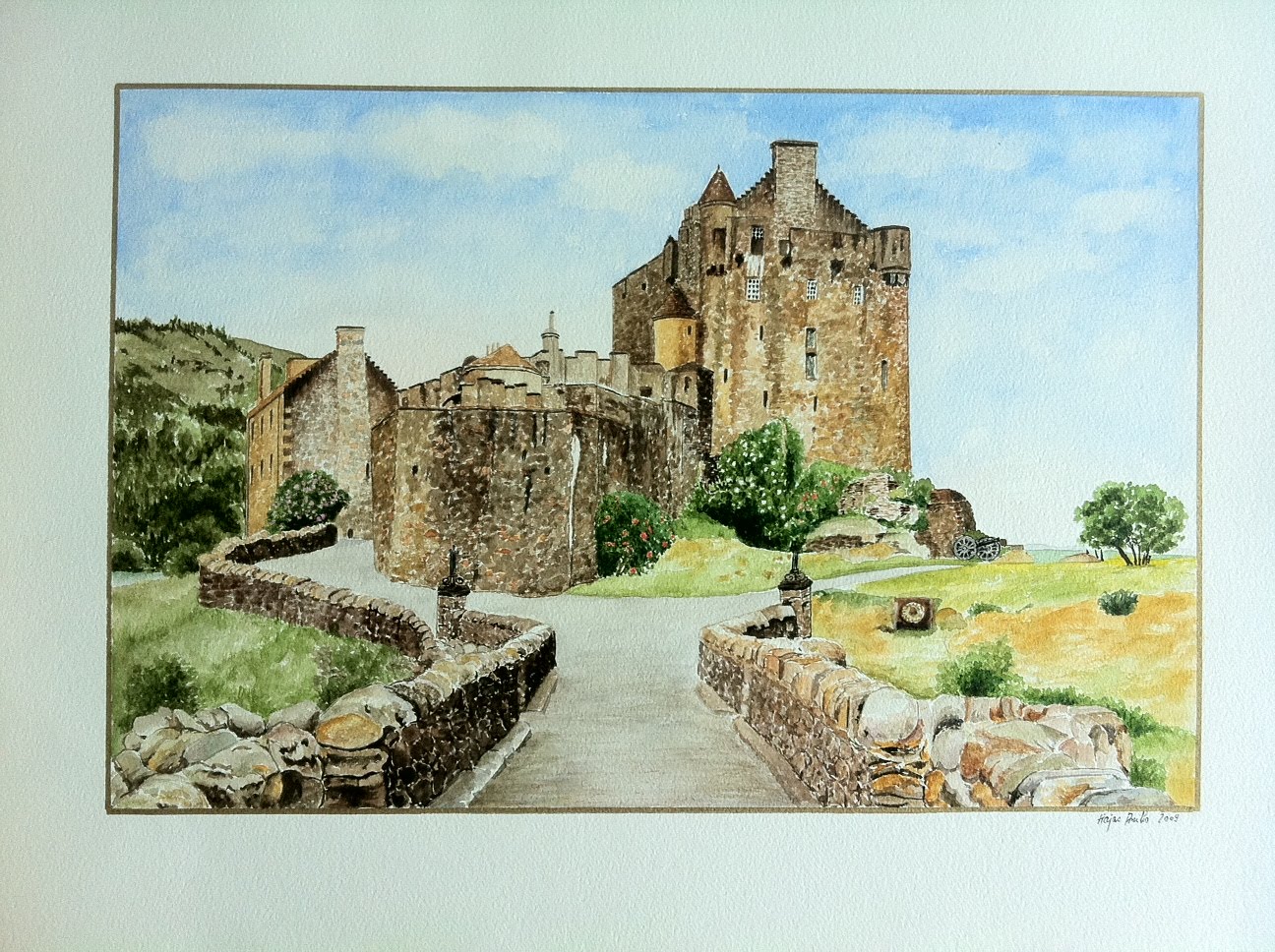
Eilean Donan Castle, Scotland reproduced from a photograph I took during our 2007 travels. It was a gift for John's birthday. Given our love of castles, this is our favorite in her collection.


This painting made especially for Trinity was reproduced from a very old fairytale book.

In recent years I have had the desire to learn how to paint and spend more time being creative/artistic. Art is a tremendous way of expressing oneself and immensely satisfying. Much more so than writing a financial plan or advising someone on how not to spend money they haven't earned (sleeeeeppy time).

However, I predominantly operate from the left side of my brain. I am very comfortable in the world of finance, organisation, logic, problem solving, reasoning... get the picture? My best friend is a right side operator and it shows in her artistic explorations. Whilst she can work from the left side (you need to be able to as a Personal Assistant), she is very comfortable with chaos (check her desk at home when she's creating), has millions of creative ideas and it is visible in her finished products. You sometimes wonder how we have sustained such a fabulous friendship for 22 years.

My difficulty as a left brain operator is that I find it difficult to tap into my creative side. Give me instructions for x-stitch, tapestry, jewellery making, sewing and I'm okay, I can deliver. Give me a colour pencil or paint brush and I just sit there staring at the canvas, having not a clue as to what to do with it. It's also perhaps why I struggle with the more creative side of photography as well. Unlike my buddy Peckster who has given me some great photos and am the proud owner of his sunset photo of the St Kilda pier and cafe (before the cafe burned down).

This was proven some years ago when my girlfriend did just that. Gave me pencils and paper. Whilst she was happily painting away, I sat staring at the drawing paper. My heart rate elevated after some time, felt stressed, frustrated and pressured. Imagine that? This was meant to be relaxing, creative and fun. That was the problem solver in me rearing its ugly head. I could not solve the problem of creating. After 3 hours I managed to scrounge together some geometric shapes and then colour them in. In 2 colours only. Red and white. There was relief though. I solved my problem. Did I have fun, hmmm can't remember, but sitting in my girlfriend's company chatting more than makes up for my lack of creativity any day of the week.

What does that have to do with colouring books? Well it is ten years on and I still can't draw but upon a visit to the Reject Shop, I came across a collection of Doodle Design colouring books. Jam-packed with gorgeous patterns and scenes, I couldn't resist picking up the Garden Fairies, World of Animals and Country Cottages. Each one of them resonated somehow with me. Having a little girl who loves animals, pink and dollies made those an easy choice. The country cottages just reminds me of the gorgeous cottages I saw throughout Scotland.

On a whim, during my 2009 Bali trip with my sister, I took a couple of the colouring books. It was the nicest flight as I whiled away the time colouring in. I have no idea what the passengers around me were thinking nor did I care. Incensed by the relaxing and fun experience, I then spent an entire afternoon (6 hours to be precise), colouring with my sister... under the palm trees, near the pool, with a Bintang or two. No stress, no pressure, no need to problem solve. Why? Because the outline is already there. I don't have to have the skill to draw it, just the inclination to experiment with colours. I have the pleasure of a pretty finished product that I can look back on and reminisce.


The afternoon was so touching to both of us that we often refer to it and prior to leaving Melbourne we did it all over again. The dining table was scattered with pencils, felt tip pens, crayons, glitter, even hijacked my nephew's awesome texta collection. It was difficult to fathom that we were two moms, 40+ playing with colouring books. But at that moment in time we were just a couple of girls enjoying the simplest thing.


Today, I unpacked the art box and came across coloured princesses and fairies and I remember the days we coloured in Bali and the afternoon around my dining table. As my sister is due to arrive for a visit in two weeks, I have an unfinished princess which she needs to complete (and we may be able to steal an afternoon just for colouring).

My conclusion is that you are never too old to colour, especially in the company of children. You don't need special artistic skills, just the desire to play. And when the going gets tough, just colour for a while, you never know what solutions may come to you when your mind has the space to think.

As for my daughter and I, I can hardly wait to colour with her and create pretty pictures. In the meantime, it's crayons and blank paper for lots and lots of scribbling, the prequel to colouring as this artwork by Trinity attests to.

04 April 2011

Floating city....

Living on the 22nd floor, we are blessed with the most sensational view of the Straits of Singapore. Sprinkled with commercial vessels of every size, our scene is everchanging as vessels come and go each day. Where have they come from and where are they going is surely pondered on many an occasion.

Singapore's strategic geographical location has made it one of the busiest ports in the world. Can you fathom that this tiny island of 700 sq km holds the record of total shipping tonnage which in 2005 was recorded at approximately 1.15 billion gross tons. It has held this record for 25 years. According to Singapore's Maritime Authority (MAS), last year the port turned over approximately 150,000 vessels. This is a staggering number wouldn't you say? Every minute, 2-3 vessels are either arriving or leaving.

Emma Maersk, one of Denmark's biggest vessels, measuring in at 397m in length, made its maiden voyage to Singapore. This phenomenal vessel is capable of carrying 11,000 containers.

Historically the port has had to compete with neighbouring ports in the Strait of Malacca. By the 15th century and following the ascendance of the Malacca Sultanate, Singapore's international trade declined and by the 17th century it had ceased to exist. Sir Stamford Raffles the founder of Singapore city was a British statesman who was so impressed with the waters in Keppel Harbour that he re-established the port and international trading commenced once again.

The anchored vessels outside my window, whilst a feast on the eyes during the day, are aptly named by John a "floating city" at night. Lit across the Strait for several kilometres, the view never ceases as far as the eyes can see. And you wonder: what do they do at nights, how do they fill in their time as they wait to reach port, what stories can the captains and crews weave, what wild storms have they passed through. I do not for one moment romanticise the notion that it would be an adventure but they are curious questions.

Perhaps if my curiosity persists, I can book a passage on a cargo liner instead of a cruise liner. I can leave my evening wear and high heels at home, and pack cargo pants and t-shirts. Photography opportunities could be interesting but what would raise my interest would really just be the stories told. Maybe one day there'll be a blog about this...

02 April 2011

A day in the lives of the Neilson family.

As I contemplate my day with sighs of satisfaction, I reflect on one of those perfect family days.

Starting with a very slow coffee and breakfast, Trinity is hankering to pull out all her animals, the dinasours and mythical figures to make a circle. After a handful of photos in the animals circle, the tea set is setup and mummy is served a cup of tea.

As the novelty wears off with the cubs spinning on the lazy susan, the wooden blocks come out. So we put the animals back in the cupboard and tea set away. The floor puzzle foam play mat is slotted together to provide seating on the floor (marble tiles look great, but they are hard and cold) and a castle is being built. Unfortunately at this stage, Trini is threatened within an inch of her life if she crashes the castle (a tendency she has acquired). Of course once the castle has been built and admired, along with some piccies, Trini is allowed to crash it and then repacked.

Lunch, juices and more coffee follow suit. Of course Trini is not interested in an afternoon nap (too much fun playing), so we choose to head out to the tennis courts. Trini was a fabulous ball girl, whilst John and I ran around rallying and dripping with sweat. We were literally drenched within 45 min and were desperate for a dip in the pool. So back upstairs we go, get changed and in no time find ourselves cooled off in the pool, a couple of Heinekens, juice for Trini and a pizza.

Trini's patience is relative to mine. Meaning ZERO. We asked her to wait before she gets back in the pool so we can finish lunch. As I keep my eyes on her, she's told not to get in without her floaties. So it went something like this: "Trini don't get in the pool, you haven't got your floaties on...", "TRINI!!! Please put your floaties on". I watch as she inches herself to the edge of the pool, knowing full well that she will jump in without her floaties. She is super confident that she can swim without the floaties. Annnnddddd off she goes into the pool without her floaties. It was surprising to note that as she was sinking, she was furiously kicking her legs to bring herself to the surface (the knowledge of treading is definitely kicking in). John, faster than Superman jumps in and lifts her out. No harm would have come to her we were too close but the lesson was learnt. "Trini can I put your floaties on now?" and the nod comes my way.

She is learning at a phenomenal rate. Last weekend she learned to tread water in 2 days and jump in the diving pool from the lowest diving board. This weekend she jumped from the highest diving board, swam the width of a 50m pool by herself and dipped underwater and through the middle of John's legs to bob up behind him. She loved it so much we kept having to practice and take turns.

After having several goes on the water slide in the toddler pool, the tropical rain arrives fast and furious and lasts barely 5 minutes. It was long enough though for us to bunk up in the cafe and indulge on ice cream. As expected with so much activity, Trini fell asleep whilst sitting but not before she finished her ice cream. And so it is 6pm and the day is over. Time for a shower and dinner.

This could be seen as a simple day but the satisfaction is in knowing that Trini had our undivided attention. No laptops, no mobiles. We had a lot of fun doing lots of things and just simply being together.

On a final note my daughter is eating the house out. So I think I am expecting a growth spurt. It is certainly long overdue. It also explains the unusual behaviours we have encountered in the last 2 days. Shortly I will be packing up all the size 2 and fishing out the size 3 clothes from under her bed storage.

So whilst I sit back enjoying a glass of white wine, I will continue sighing with satisfaction and look forwards to Sunday and whatever it brings our way.

30 March 2011

A very special day....

Today I celebrated my very first birthday in Singapore and whilst I stopped counting after 39 years of age, I do still celebrate them well.

What made this birthday so unique from all the rest was the extraordinary amount of birthday wishes from all walks of my life.

I spent the majority of my birthday Facebooking, Skyping or Emailing thank yous. I felt very special, very very loved and sorely missed. Nothing else is comparable to feeling like a queen for a day (ok, so in my own mind I am queen of my own galaxy all the time and John just plays along with it whilst Trini overules it).

From the first Happy Birthday from hubby along with a very nice cup of coffee, to close friends, friends from playgroup, friends from childhood, friends from school, friends from old neighbourhoods, ex-colleagues, to the international call from my best friend, the beautiful eVideo from my sister, Trini singing to me Happy Birthday and the spectacular dinner I had at a seafood restaurant.

I thank each and every one of you from the bottom of my heart for making today so special and wonderful. No birthday party or quantity of presents could have surpassed the beauty of today.

With half an hour left of feeling a queen for a day, I will spend it relishing every single moment of today.

Thank you.

Silv


These beautiful roses are from John...


... and these white stunners are from Mon.

29 March 2011

Genghis Khan, Shipwrecked Treasures & the ArtScience Museum

The ArtScience Museum was open to the public on 19 February 2011. It is a most amazing architecural structure. The building is shaped like a half open hand with the fingers reaching for the sky. Its roof formed like a glass dish collects water and continuously falls 35m through the central atrium of the building as a waterfall, which is then collected and recycled.


This highly modern building designed by Moshe Safdie opened with 3 major oriental exhibitions: Genghis Khan, Shipwrecked Treasure and Travelling the Silk Road.

These exhibitions were an experience I have never had before in a museum and took John and I a "measly" 5 hours to get through. We completely immersed ourselves into the exhibitions. They were beautifully presented and learned more about Genghis Khan throughout this exhibition than if I had to read a book about it.

Genghis Khan

Born in the early 12th century as Temujin, he spent 20 years unifying the nomadic tribes of Northeast Asia bringing about stability, ethnic identity and reinforced traditions. He also introduced the Mongolian script writing system and the first written Mongolian law (albeit kept secretly and only viewed by him and his closest advisers). Following unification and successful military campaigns he was bestowed the title Genghis Khan thereby making him the ruler of Mongolia for the next 20 years of his life.

Renown for being an excellent military strategist he was also quite surprisingly a fair leader. He valued loyalty above all else and promoted based on merit not favoritism or family ties. He understood that loyalty was born of sharing the spoils of war and treating the conquered tribes with dignity. Instead of driving the defeated tribes away or abandoning them he would integrate them into his own tribe and provide them with protection.

In order to cement alliances between tribes he married at the age of 16 to Borte whom he was promised to when he was only nine. Together they had four sons. Although he had many wives and children, they were of a lower status thereby excluding the children from succession.

Mongolian soldiers were mind-blowing horse riders and archers. The bows took a year to construct and they often slept with them to stop the bows from stiffening in the cold. A Mongolian bow had a shooting range of 320m which was 100m further than the English longbow. They were such expert archers that they could shoot an arrow whilst facing backwards on a horse or hanging at the rear and besides the horse for protection. To keep their aim true they would release their arrows when all four feet of the horse were off the ground. Talk about precision timing and how in tune they would have had to be with their horses.

Before he died, Genghis Khan divided the empire amongst his sons and grandsons. The Mongolian Empire continued to spread for a further couple of generations but due to in-fighting between his descendants the empire began to fracture and finally dissolved in the mid-14th century when the native Chinese overthrew Kublai Khan who was the founder of the Yuan Dynasty, the last Mongolian leader and one of Genghis Khan's grandsons.

At the height of its success the Mongolian Empire consisted of most of Asia, parts of Eastern Europe and North Siberia (approximately 22% of Earth's land area). It is known as the largest contiguous empire in the world, which at the time had a population of 100 million.

Genghis Khan is a highly regarded figure in Mongolia's history and considered as the founding father of today's Mongolia.

In a nutshell, Genghis Khan inspired loyalty amongst his troops, was a military strategist, a strong and fair leader and a great visionary.


Shipwrecked - Tang Treasures and Monsoon Winds

Imagine going out diving for sea cucumbers and three kilometers from shore you come across an unusual bump beneath the ocean. Upon further investigation you discover a cargo laden shipwreck in only 16 metres of water that has been resting beneath the ocean for a 1000 years.

It's 1998 and near Belitung Island, Indonesia which is about 600km south-east of Singapore a 9th century Arab dhow (Arab sailing vessel) is found and then excavated. The cargo hold of the dhow is laden with 60,000 objects, such as mass produced ceramics, Chinese blue & white dishes, silver, gold and bronze items. The surprise isn't just the quantity of items discovered but the fact that a large proportion of them are still intact. Partly due to tightly-packed wares in ginormous jars and partly due to sediment covering the dhow and preserving the wood from rotting and hence the goods held within it.

It is not difficult to fathom the treacherousness and inefficiencies of transporting goods to the West via the Silk Road route which was often afflicted by bandits. So the maritime silk route rose to the occasion and expedited the transportation of goods from China to Europe and Africa. Travelling by dhow was fast, efficient and able to transport large quantities of goods. Of course it did have its own risks such as hazardous weather, pirates and disease.

What is fascinating to note is that the vast portion of the cargo consisted of mass produced Changsha wares. It shows that even back in the 9th century the Chinese had the capacity and capability to produce ceramics on an industrial scale. Europeans loved the Chinese imports as you may often see nowadays in castles' crockery collections (particularly the Chinese blue & white patterns).

The dhow's typical sea journey would have commenced in Oman (east of Saudi Arabia), coursing through the Arabian Sea via India and Sri Lanka, steering north of Indonesia through the Strait of Malacca, around Singapore and then north to Guangzhou, China. Here it loaded the dhow with goods and commenced its return journey. What remains a mystery is why the dhow didn't turn north-west into the Strait of Malacca but kept southward of Singapore until it sunk in the Gelasa Strait between Belitung and Bangka Islands. One can imagine that a possible explanation is being blown off course by a storm and crashing into shallow reefs and submerged rocks which the Gelasa Strait is known for. Who knows!?

Purchased for $32m by a private company together with the Singaporean Government a small selection of the cargo has made its debut at the ArtScience Museum where it is being showcased until it departs for a world wide tour for the next five years. At the end of the tour the exhibition will be permanently housed in Singapore.

The commercial excavation of the underwater archeological site was highly contentious. Professional organisations dedicated to maritime archeology were concerned that the painstaking task of documenting the excavation and preserving the site would be compromised and give way to plundering and accidental destruction.

The excavators understood the extraordinary history and value of such a find and had the ethical philosophy to keep the cargo intact so that it could be studied in its original context.

For me it was a privilege to be privvy to such a stunning discovery and have an insight into a world gone by.


The Silk Road

A transcontinental route extending 6500km, the Silk Road gets its name from the Chinese silk trade which began around 200BC. Silk making was a highly guarded secret by the Chinese thereby making silk a valuable item. Of course silk wasn't the only item traded on these routes. Perfumes, spices, medicines, jewels were amongst other things.

During the Mongol Empire trading was easily done on the Silk Road because the Mongol's would have checkpoints along the way ensuring travel safety. Unfortunately when the Empire fell the route was unprotected and opened up to swarms of robbers. Over time trading on the route declined until it dissolved.

The Silk Road connected much of Asia to northern Africa, Europe and the Mediterranean. A perilous route due to its mountains and harsh desserts, the caravans filled with goods moved from location to location, selling and trading their wares. Agents were used to travel between locations as it would have been impossible for any one merchant to make the journey in its entirety.

Through dioramas and written boards, the exhibition recreated a part of the Silk Road journey commencing in Xi'an and ending in Baghdad. In Xi'an we watched silk worms spin cocoons and admired and wondered at the five meter silk loom (a very large and complex contraption). Arriving in Turfan we looked at the displays of feathers, furs and spices and the raucousness of the night market. Next stop was Sarmakand showing the ancient craft of papermaking and finally arrived in the bustling town of Baghdad a hub of commerce and scholarship.

We emerged from the Museum a little more cultured and with a little more appreciation for history.

18 March 2011

A date with my husband...

After nearly 4 months of no solitary time just the 2 of us, it was a delight to wake up on Wednesday morning and know that we can have half a day doing something together.

We hopped on the train and wondered into Raffles City Mall. Probably the second most prestigious Mall in Singapore. Whilst we waited for the stores to open (most things don't open till about 11am) we trekked our way to the Basement and like magnets got drawn into J. Co Donuts and Coffee Shop. With loads of pleasure we devoured a couple of donuts each along with a coffee each. The donuts had a wonderful light and fluffy texture unlike the ones we've had in Oz which often end up being heavy like a brick.

We then made a pitstop at Robinson's which is the Oz version of David Jones to look for some business shirts. We were perplexed at being told that the David Hechter brand of shirts we were after is only stocked during Chinese New Year, then any surplus stock is sent back to the suppliers. So if we want anymore of the same shirts, wait till next year. Fair enough.

From here John takes the courage to have his first haircut in Singapore. There are several salons next door to each other in the Basement. He first checked all the prices which ranged from $10 to $35. After watching one particular hairdresser he was quite impressed with the way the hairdresser was taking his time with the cut. It was a successful trip. For $10, John got the best haircut I have seen on him in years.

Whilst John is getting a cut, I check out the local bookstore. I really enjoyed meandering through it, particularly the children's section. I came across the Usborne Publisher, a UK based company which publishes a wonderful and award winning collection of books for all levels of young readers, toddlers, teenagers and so on. Now you know how much I love books but even more so when the books are for Trinity. My love of books, have transcended onto Trini and finding a whole new collection that we can add over time will become one of those fun trips to the bookstore that we used to take at QBD Bookstore at Doncaster Shoppingtown.

However, if you are into business/finance related books consider this collection the shop stocked: 5 bookshelves on investments, 2 on finance, 5 on business management, another 5 on marketing and another 5 on miscellaneous business/finance related books. Do you think that sums up Singapore as a financial hub? Pretty much. Singaporeans place high value on education and finance and it is visible everywhere you go. The toys, the books, the concentration on enrichment programs in the schools starting with the Early Development Centres, taxi drivers (they will ask you outright how much you earn?!?!?!) and anyone else you speak to.

Now let me tell you about the most divine Asian lunch we shared today. After going around in circle in their foodcourt, we come across one place that isn't packed to the hilt and has a desirable looking menu. The Teahouse Asian Kitchen is not big but has gorgeous decor, excellent service and even more excellent food. We hoed into the following (see photos on Facebook - Gastronomy folder):

* Teahouse Fried Rice: fluffy rice with thinly sliced sausages that are slightly sweet and shrimps;
* Chicken Mushroom Pot: chicken pieces with spring onions, BBQ sauce and possibly oyster sauce, shallots, whole garlic and shiitake mushrooms;
* Broccoli with Shrimp: steamed broccoli, fat pieces of shrimp, spring onions, thin slices of ginger and crushed garlic; and
* Bottomless cups of Chinese Tea.

Total price $32. Total value for money 100%. We took out a membership with them, as we know we are going to be back. It will become one of those special haunts of ours. There are many more dishes on their menu to be tried and tested. I hear that they are duck specialists so that will be the next visit.

With stomach full, caffeinated, sweets devoured, hair cut accomplished and a nice walk around we wrap up the morning and go home. From here John gets dressed and finally goes off to work.

Silv